
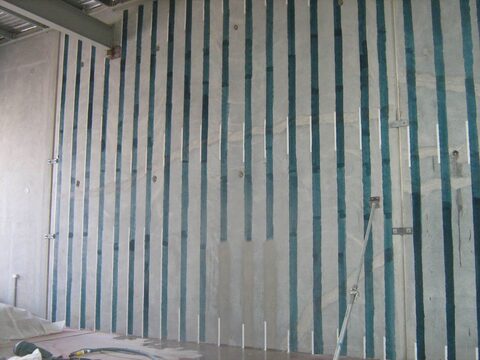
When evaluating a carbon fiber reinforced polymer (CFRP) system for structural strengthening, the technical data sheet (TDS) is your primary source of material properties. However, interpreting the reported values—particularly tensile strength, elastic modulus, and elongation at break—requires an understanding of what each metric means and how it is measured. This article explains these key parameters in the context of CFRP laminates (fabric or plate) as used in externally bonded reinforcement, following common industry practices outlined in documents such as ACI 440.2R and the fib bulletin.
Tensile Strength: Capacity Under Load
Tensile strength is the maximum stress a CFRP material can withstand when pulled in tension before failure. On a TDS, this value is typically reported in ksi (thousand pounds per square inch) or MPa (megapascals). For carbon fiber products, tensile strength can range from 350 to over 700 ksi (2,400–4,800 MPa). It is important to note that the reported tensile strength is usually based on the net fiber area (the cross-sectional area of the carbon fibers alone, excluding the matrix). The TDS should clearly indicate whether the value refers to the fiber, the composite (laminate), or a specific ply thickness. When comparing products, ensure you are comparing the same basis. The strength value directly affects the number of layers or the cross-section required to resist a given design load.
Elastic Modulus: Stiffness and Deformation
Elastic modulus (Young’s modulus) describes the stiffness of the CFRP—how much it deforms under a given stress. It is reported in msi (million pounds per square inch) or GPa (gigapascals). Standard modulus carbon fibers have a modulus around 33 msi (230 GPa), while intermediate and high modulus fibers reach 40–55 msi (280–380 GPa). A higher modulus means the material will stretch less under load, which is critical when controlling deflections in strengthened structures. However, higher modulus fibers often have lower ultimate strain (elongation), so the choice involves balancing stiffness and ductility. The TDS should state whether the modulus is initial tangent or secant modulus; for linear-elastic CFRP, this distinction is usually minor. The modulus is key for serviceability limit state checks per ACI 440.2R.
Elongation at Break: Ductility and Warning
Elongation at break (also called ultimate strain) is the maximum strain the CFRP can sustain before rupture, expressed as a percentage. Typical values range from 1.0′ to 2.0′ for standard carbon fibers. This metric indicates how much the material can stretch before failure, which is important for compatibility with the concrete substrate and for providing some warning before fracture. A higher elongation generally means better ability to conform to curved surfaces and greater deformability, but it may correlate with lower modulus. The data sheet often reports both the guaranteed and mean elongation; engineers typically use the guaranteed value for design. Standards recommend multiplying the guaranteed ultimate strain by a strength reduction factor (e.g., 0.65–0.85 for environmental exposure).
Testing Standards and Reporting Conditions
CFRP tensile properties are determined by tests per ASTM D3039 or ISO 527-5 using a prescribed coupon geometry. The TDS should list the test method and temperature/humidity conditions. Differences in test speed, specimen type, or conditioning can affect results. For example, values from a flat coupon test may differ from those from a curved beam test for fabrics. Always confirm that reported properties are based on the cured laminate thickness (the design thickness, often the nominal fiber thickness plus the epoxy). ACI 440.2R provides guidance on converting from fiber-area properties to design properties. Beware of data sheets that report only “pre-cured” properties if you are using a wet lay-up system—the in-situ cured laminate properties may vary.
How These Properties Interrelate
Tensile strength, modulus, and elongation are not independent. For CFRP, they are linked by the stress-strain curve: stress = modulus × strain (within the linear range). The ultimate tensile strength divided by the modulus gives the ultimate strain (elongation). This relationship allows you to verify if the reported numbers are consistent. For instance, if a carbon fiber plate has a tensile strength of 400 ksi and modulus of 33 msi, the calculated strain is 0.0121 (1.21%), which should match the reported elongation. Discrepancies may indicate different test bases (e.g., strength measured at fiber area but modulus at laminate area). Understanding this interplay helps in selecting a material that provides adequate strength without overloading the concrete or causing excessive creep.
Practical Considerations for Material Selection
When reading a TDS, first note the design thickness and fiber areal weight. Then examine the tensile strength and modulus: for flexural strengthening of a beam, a high modulus helps control crack width, while for shear strengthening, high strength may be more important. Elongation must be compatible with the concrete’s tensile strain capacity (typically 0.010–0.015). If the CFRP cannot elongate enough to match the concrete at ultimate, premature debonding may occur. Also check environmental reduction factors: for outdoor exposure, some data sheets report properties after conditioning at high temperature or moisture. Finally, ensure the values are minimum guaranteed against a stated number of samples, not just averages. This ensures a reliable design consistent with limit state design philosophy.
Understanding these three core properties empowers engineers to select the right CFRP system for each application. A data sheet that transparently reports these values, with clear test conditions and design bases, is a sign of a quality product. Always cross-reference with the manufacturer’s design guide or a recognized standard like ACI 440.2R to convert reported properties into usable design values.