
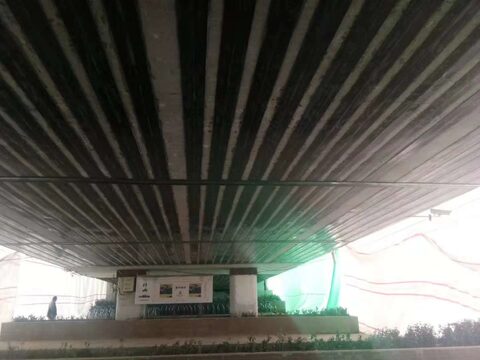
Surface preparation is arguably the most critical step in the installation of externally bonded carbon fiber reinforced polymer (CFRP) systems. Even the highest quality carbon fiber fabric and epoxy will fail prematurely if the concrete substrate is not properly prepared. The bond between the CFRP and the concrete surface is the primary load transfer mechanism; therefore, achieving a sound, clean, and properly profiled surface is essential for the long-term performance of the strengthening system. This article outlines the key steps and quality control measures necessary to ensure optimal bond strength for CFRP installation, following the guidance of standards such as ACI 440.2R.
Why Surface Preparation Matters
The bond between a CFRP laminate and concrete is dependent on mechanical interlocking and chemical adhesion. Concrete surfaces that are contaminated, laitance-rich, or uneven can significantly reduce the effective bond area and create weak points that may lead to delamination. Research and field experience have shown that a properly prepared surface can achieve bond strengths exceeding 2.0 MPa (300 psi) in shear, whereas a poorly prepared surface may yield less than 0.5 MPa. The goal of surface preparation is to remove all surface contaminants, expose sound aggregate, and create an open-pore texture that allows the epoxy saturant to penetrate and mechanically lock into the concrete.
Step 1: Substrate Evaluation and Repair
Before any surface preparation begins, the existing concrete must be evaluated for soundness. Inspect the surface for signs of delamination, spalling, cracks wider than 0.3 mm (0.012 in.), or any other defects. Use chain dragging or hammer sounding to locate hollow areas, as these indicate delaminations that must be removed. All unsound concrete, including areas with carbonation or alkali-silica reaction, should be removed and patched with a compatible repair mortar. Cracks wider than 0.3 mm should be injected with a low-viscosity epoxy. Only after the substrate is structurally sound should surface preparation proceed.
Step 2: Cleaning and Profiling
The most common methods for preparing concrete surfaces for CFRP bonding are abrasive blasting, grinding, and water jetting. The objective is to remove all laitance, curing compounds, dirt, grease, and other contaminants while exposing a uniform, open-textured surface. Abrasive blasting (sandblasting or shot blasting) is generally preferred because it efficiently cleans and profiles the surface simultaneously. Grinding with diamond cup wheels is also effective for small areas or where dust control is critical. Water jetting at pressures above 10,000 psi can be used but must be followed by a period of drying. The final surface profile should be equivalent to Concrete Surface Profile (CSP) 3 to 5 as defined by the International Concrete Repair Institute (ICRI). This corresponds to a surface that is slightly rough to the touch, similar to medium-grit sandpaper, allowing the epoxy to form a strong mechanical bond.
Step 3: Moisture Content and Drying
Moisture in the concrete can interfere with epoxy curing and bond development. The moisture content of the substrate must be checked using a moisture meter or by performing a simple plastic sheet test (ASTM D4263). For most epoxy systems, the surface moisture level should be below 4% or the substrate should be surface-dry, as recommended by the epoxy manufacturer. If the concrete is damp, forced drying with heat guns, dehumidifiers, or infrared heaters may be necessary. In some cases, moisture-tolerant primers are available and can be used if the manufacturer permits. However, it is always best to achieve a dry surface condition before saturating the CFRP.
Step 4: Bond Testing and Quality Control
Before proceeding with the full installation, it is advisable to perform a pull-off adhesion test (ASTM C1583) on a prepared test area. The test provides a quantitative measure of the substrate tensile strength and the quality of the surface preparation. A minimum bond strength of 1.5 MPa (220 psi) is commonly specified, though higher values are desirable. If the test fails, the surface preparation method must be adjusted and retesting performed. After the CFRP is installed, additional pull-off tests can be performed on witness panels or sacrificial coupons to confirm the in-situ bond quality. Document all test results as part of the quality control report.
Step 5: Handling Irregularities and Corners
Special attention must be given to corners, edges, and other geometric discontinuities. CFRP fabric tends to lift at inside corners if not adequately pressed into the epoxy. Rounding of sharp corners to a radius of at least 13 mm (0.5 in.) is recommended to reduce stress concentrations and prevent voids. For inside corners, apply a small fillet of epoxy putty to create a smooth transition. Outside corners should also be slightly rounded. In areas where the concrete surface has honeycombing or bug holes, fill these voids with a compatible epoxy paste or primer before laminating. Such irregularities can trap air and lead to disbonding if not addressed.
Closing
Proper surface preparation is not merely a preliminary step but a quality assurance process that directly dictates the performance of the CFRP strengthening system. By following the guidelines of industry standards such as ACI 440.2R and ICRI, the installer can achieve a bond that transfers loads effectively and remains durable over the service life of the structure. Investing time in careful surface evaluation, cleaning, profiling, moisture control, and testing will pay dividends in the long-term reliability of the retrofit.