
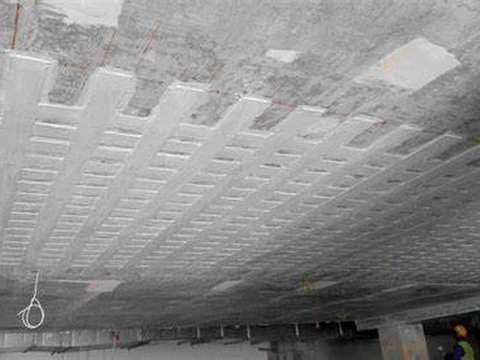
For owners and engineers considering carbon fiber reinforced polymer (CFRP) systems for structural strengthening, long-term durability is a central concern. Properly designed and installed CFRP systems can provide decades of reliable service, but their performance must be assessed under realistic environmental conditions. This article examines the key environmental aging factors—moisture, temperature, UV radiation, and chemical exposure—and reviews how they affect the mechanical properties and bond integrity of CFRP systems. Understanding these effects, as guided by codes such as ACI 440.2R and fib Bulletin 14, allows engineers to specify appropriate protection measures and safety factors for enduring performance.
Moisture and Humidity Effects
Moisture ingress is one of the most studied durability concerns for CFRP. Water molecules can diffuse into the epoxy matrix, causing plasticization, hydrolysis, and microcracking. In CFRP laminates, moisture absorption typically follows Fickian diffusion, with saturation levels of 0.5% to 5% by weight depending on the epoxy formulation. The primary effect on mechanical properties is a reduction in glass transition temperature (Tg) and a moderate loss of interlaminar shear strength (ILSS).
For the CFRP-to-concrete bond, moisture can degrade the epoxy–concrete interface, especially if the substrate is not properly dried before application. Cyclic wet–dry conditions are more damaging than constant immersion because they create osmotic pressure and cyclic swelling stresses. To mitigate moisture effects, designers should specify low-moisture-absorption epoxies, apply sealers, and ensure proper surface preparation. ACI 440.2R recommends reduction factors for wet service conditions.
Temperature and Thermal Cycling
CFRP systems must operate within the service temperature range of the structural adhesive and the fiber reinforcement. Typical curing and service limits are 60°C to 80°C for ambient-cure epoxies, while high-temperature formulations can reach 120°C or more. The critical parameter is Tg; above this temperature, the epoxy softens, and bond strength drops sharply.
Thermal cycling between hot and cold extremes can cause microcracking in the epoxy due to differential thermal expansion between carbon fibers (near-zero coefficient) and the matrix (about 30–50 × 10−6 /°C). Over many cycles, this can reduce fatigue resistance, though complete failure is rare if the Tg is not exceeded. Fire exposure is a related concern: CFRP loses strength above 300–400°C, so fire-rated systems need passive protection (e.g., intumescent coatings or cementitious overlays). Designers should consult test data for elevated-temperature dwell and thermal cycling according to ASTM or ISO standards.
Ultraviolet (UV) Radiation
UV radiation from sunlight primarily attacks the epoxy matrix. The fibers themselves are UV-stable, but the surface resin layer can become brittle, chalky, and microcracked when exposed directly. This degradation is typically limited to the outer 0.1–0.5 mm and does not affect the load-bearing capacity of the fiber lamina unless the protective layer is completely eroded.
For outdoor applications, UV protection is essential. Manufacturers supply gel coats, UV-resistant paints, or sacrificial layers. Alternatively, a cementitious or mortar coating over the CFRP provides full UV shielding while also offering fire and impact resistance. ACI 440.2R advises that exposed CFRP be protected if the structure is in a zone of high solar radiation or where aesthetics are important. Long-term UV exposure data from accelerated tests (e.g., QUV per ASTM G154) can guide coating selection.
Chemical Exposure and Alkaline Attack
In concrete strengthening, CFRP is most often applied to reinforced concrete structures that may be exposed to deicing salts, sulfates, or acidic environments. The carbon fibers themselves are highly resistant to most chemicals, but the epoxy matrix can be attacked by strong alkalis (pH > 12) such as fresh concrete pore water. This is particularly relevant for CFRP bars or embedded laminates in new construction.
For externally bonded systems, surface sealers and protective coatings defend against chemical ingress. In aggressive environments (e.g., chemical plants, parking garages), special epoxy formulations with higher chemical resistance should be specified. If CFRP is used in direct contact with fresh concrete (as in FRCM systems), the matrix must be alkali-resistant. Codes like ACI 440.2R require that environmental reduction factors be applied to the design tensile strength when chemical exposure is anticipated.
Bond Durability and Voids
The long-term performance of a CFRP system hinges on the integrity of the adhesive bond, not just the fiber itself. Environmental aging can weaken the interface between the CFRP and concrete, leading to debonding. Moisture, freeze-thaw cycles, and sustained loading (creep) all reduce bond strength. Voids in the resin layer or entrapped air at the interface are sites for moisture accumulation and stress concentration.
Quality control during installation—proper surface preparation (e.g., grit-blasted, cleaned, dry), controlled viscosity, and vacuum bagging for laminates—minimizes voids. Regular inspection for blistering, delamination, or discoloration is recommended. For critical structures, accelerated aging tests on mock-ups can be used to validate long-term bond durability.
Designing for Long-Term Performance
To achieve the 30- to 50-year service life typically required for civil infrastructure, engineers must account for environmental effects in design.
- Environmental reduction factors: ACI 440.2R provides a factor CE (0.65 for exterior exposure, 0.85 for interior) that multiplies the ultimate tensile strength.
- Material selection: Use epoxies with high Tg, low moisture absorption, and UV additives.
- Protective layers: Coatings, cementitious overlays, or intumescent finishes address UV, fire, and chemical threats.
- Monitoring and inspection: Periodic surveys for cracking, discoloration, or hollow-sounding areas detected by tapping or thermography.
Ongoing research continues to refine predictive models for residual strength after decades of service. Following established building code provisions and manufacturer recommendations ensures that CFRP strengthening remains a reliable, durable solution.
In summary, while CFRP systems are susceptible to environmental aging from moisture, temperature, UV, and chemicals, proper design, material selection, and protective measures can effectively limit degradation. By understanding the mechanisms outlined in this article and applying the reduction factors and quality controls referenced in codes like ACI 440.2R, engineers can confidently specify CFRP for long-term structural performance.